What is tajweed, and why learn it?
Tajweed, also spelled tajwid, concerns the careful pronunciation of Quranic recitation: producing letters distinctly and observing the rules that apply as sounds meet. Quran 73:4 provides the principle of measured recitation. Studying the rules gives you vocabulary for understanding a correction, while hearing and practising the sound turns that knowledge into reading ability.
You do not need to sound like a famous reciter to begin. Choose clarity over performance. A useful first goal is to read a familiar short passage slowly enough that you can notice each letter and follow your teacher’s correction. Melody should never become a reason to stretch, omit or alter a sound.
Where should a complete beginner start?
Ask for a short reading assessment. If you cannot recognise connected Arabic letters, start with a beginner reading book, often called a qaida, rather than a list of advanced tajweed rules. If you can decode words but confuse particular sounds, ask your teacher to identify those sounds first. Someone who reads fluently may still need correction.
Keep a small practice record with the date, verse reference and one correction to work on. Write a plain description such as “check this letter with my teacher” instead of inventing a phonetic spelling that you may later mistake for the Quran. At your next lesson, recite the same passage before adding new material.
- Can I recognise the letters when they connect inside a word?
- Can I distinguish short vowels, a vowel-less letter and a doubled letter?
- Can I follow a teacher’s model without guessing from memory?
- Which specific sound or stopping point should I practise before the next lesson?
Which tajweed rules should I learn first?
The table is an orientation to common lesson topics, not a complete set of sound instructions. The linked teaching materials cover these topics in stages. Ask your teacher to demonstrate each one inside a real passage. Learning the label is useful only when you can hear what changes and apply the correction.
| Topic | What to notice | Useful practice question |
|---|---|---|
| Letters and vowel marks | The difference between each sound and its written signs | Am I reading the actual marks or relying on familiarity? |
| Madd | Controlled lengthening of particular sounds | Which length is my teacher demonstrating here? |
| Ghunnah | A nasal sound in its relevant recitation settings | Can I hear and reproduce the model without exaggeration? |
| Noon sakinah and tanween | Rules commonly named izhar, idgham, iqlab and ikhfa | Which following letter changes the treatment here? |
| Meem sakinah | How a vowel-less meem is treated in context | What changes when I join these words? |
| Qalqalah | A specific release in the relevant letters and conditions | Am I adding a full vowel that is not written? |
| Stopping and restarting | How to finish and resume a phrase appropriately | Where should I restart if my breath runs out? |
How can I practise tajweed at home?
Use a short passage already checked in a lesson. First listen while following the Arabic, then read it aloud and focus on your current correction. Repeat only as long as you remain attentive. Finish by reading the whole passage so that an isolated exercise reconnects with the surrounding words. This is a suggested study routine, not a prescribed devotional count.
If you record yourself privately, compare one feature at a time: a letter, a vowel length or a pause. Bring uncertainty to your teacher rather than deciding that two recordings must sound identical in every detail. Reading styles and voices differ. The question is whether you are applying the taught recitation accurately.
- Prepare the correct verse and your teacher’s latest note.
- Listen to the assigned model with the text visible.
- Read the selected portion aloud, applying one correction.
- Read it within the complete passage and note any uncertainty.
- Return to the same passage at your next lesson for feedback.
Do audio, transliteration and colour-coded Qurans help?
Audio gives you a model, and Quran.com documents reciter and repeat settings that can support listening practice. Follow a recording your teacher recommends. Keep the same recitation tradition across your text and audio; ask before combining unfamiliar editions or readings. This guide points to recitation resources; it cannot assess your pronunciation.
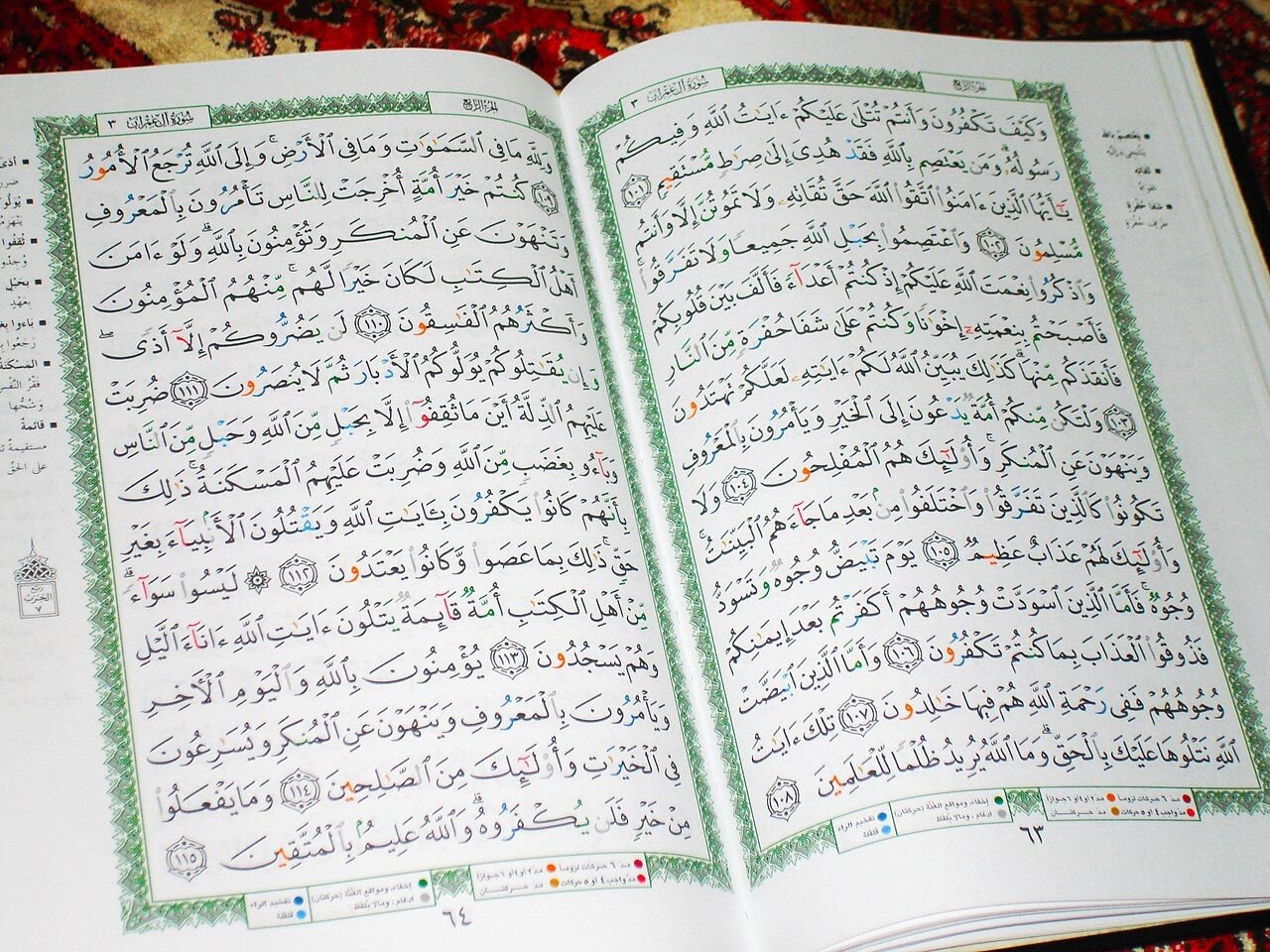
Transliteration can be a temporary prompt, but it cannot capture every Arabic sound reliably. Colour-coded editions can remind you of a rule after it has been explained; their colours are not a substitute for the legend or for listening. Avoid taking a screenshot of coloured words and assuming every Quran edition uses the same key.
What should I look for in a Quran teacher?
Ask what they teach, how they assess beginners, and how much of each lesson is spent listening to the learner. Request an explanation of their relevant training and the reading tradition they teach. A useful trial lesson should leave you knowing both what to practise and how the teacher will check it next time.
Choose a pace and setting in which you can ask questions comfortably. For a child, a parent or guardian should understand the lesson arrangement and safeguarding policy. Online lessons need usable sound and a quiet enough connection for correction. If audio repeatedly cuts out, reschedule the assessment rather than guessing whether a sound was correct.
How do I know I am improving?
Measure a specific skill in a familiar passage: fewer prompts for a difficult letter, more accurate vowel lengths, or a reliable restart after a pause. Ask your teacher whether the improvement also appears in a new passage. Finishing a worksheet is not the same as applying its lesson when reading independently.
Sahih Muslim 798a encourages the person who recites with difficulty; struggle is not a reason to abandon learning. It is also not a reason to avoid correction. If practice becomes exhausting, shorten the portion and keep the next lesson manageable. Speech or hearing differences may require an adapted approach with suitable support.
Quran passages in this guide
Read each complete verse below in Arabic and the identified English interpretation. Follow the context link before drawing conclusions from an isolated verse.
Al-Muzzammil 73:4. The Quranic foundation for measured recitation; the complete verse is rendered from the verified corpus.
أَوْ زِدْ عَلَيْهِ وَرَتِّلِ ٱلْقُرْءَانَ تَرْتِيلًا ٤
Or add to it, and recite the Qur’an with measured recitation.
Translation: Saheeh International · Read in context
Questions readers often ask
Can I learn tajweed by myself?
You can learn terminology and practise with reliable recordings independently, but a qualified listener is needed to check what you actually pronounce. Arrange feedback even if much of your study is at home.
How long does it take to learn tajweed?
There is no reliable universal completion time. Starting literacy, practice, feedback and the level you want to reach all matter. Agree on a skill-based goal with a teacher instead of a guaranteed number of weeks.
Should I stop reading the Quran until my tajweed is perfect?
Continue learning with a manageable passage and correction. Sahih Muslim 798a encourages the struggling reciter. Questions about a particular error in obligatory prayer should be taken to a qualified teacher or scholar.
Is a Quran reading planner a tajweed course?
No. A reading planner helps divide a reading target across days. It does not hear your recitation, choose pronunciation lessons or certify accuracy; those require a separate learning and feedback plan.
Sources
-
Quran 73:4: measured recitation Primary text
The verse supports measured recitation; the practical study routine here is an editorial suggestion.
-
Understand Al-Quran Academy: Learn Tajweed course materials Teaching resource
The academy’s staged lesson index includes recitation topics and guided surah practice. It is an external teaching resource, not a certification of this article.
-
Understand Al-Quran Academy: Read Quran course materials Teaching resource
Foundational Arabic reading and introductory tajweed topics, including letters, ghunnah and qalqalah.
-
Quran.com: Simplifying Word by Word and Audio Settings Provider documentation
Documents audio, reciter and repeat controls. External interface details may change.
-
Sahih Muslim 798a Hadith
Encouragement for both the proficient reader and the person who recites with difficulty.
Qur’an Arabic: Tanzil (CC BY 3.0). English: Saheeh International (via Tanzil).